Search2Adapt: Multi-Agent Collaborative Tree Search for Source-Free Unsupervised Domain Adaptation

Yulong Shi, Wenwen Zhang, Ziyi Li, Lin Qi*
Northeastern University, Shenyang, China
Accepted to ACM MM 2026 CCF-A, CORE A*
* Corresponding author.

Abstract

Source-Free Unsupervised Domain Adaptation (SFUDA) aims to adapt a pre-trained source model to unlabeled target domains without accessing source data. Traditional SFUDA methods rely on static pseudo-label generation, which often leads to suboptimal adaptation due to error accumulation and lack of feedback mechanisms. We present Search2Adapt, a novel multi-agent collaborative framework that reformulates SFUDA as a dynamic strategy search problem. Our approach introduces Collaborative Tree Search (CoTS), a plan-level search algorithm that enables efficient exploration of pseudo-label refinement strategies through multi-agent collaboration. The framework employs a closed-loop decision process where a Perceptor analyzes domain characteristics, a Strategist proposes adaptation plans, and an Evaluator provides multi-dimensional feedback without ground-truth labels. A Dynamic Prior Memory accumulates successful strategies across samples for accelerated adaptation. Extensive experiments on medical image segmentation benchmarks demonstrate that Search2Adapt achieves state-of-the-art performance, surpassing existing methods by significant margins while maintaining computational efficiency.
Search2Adapt Framework

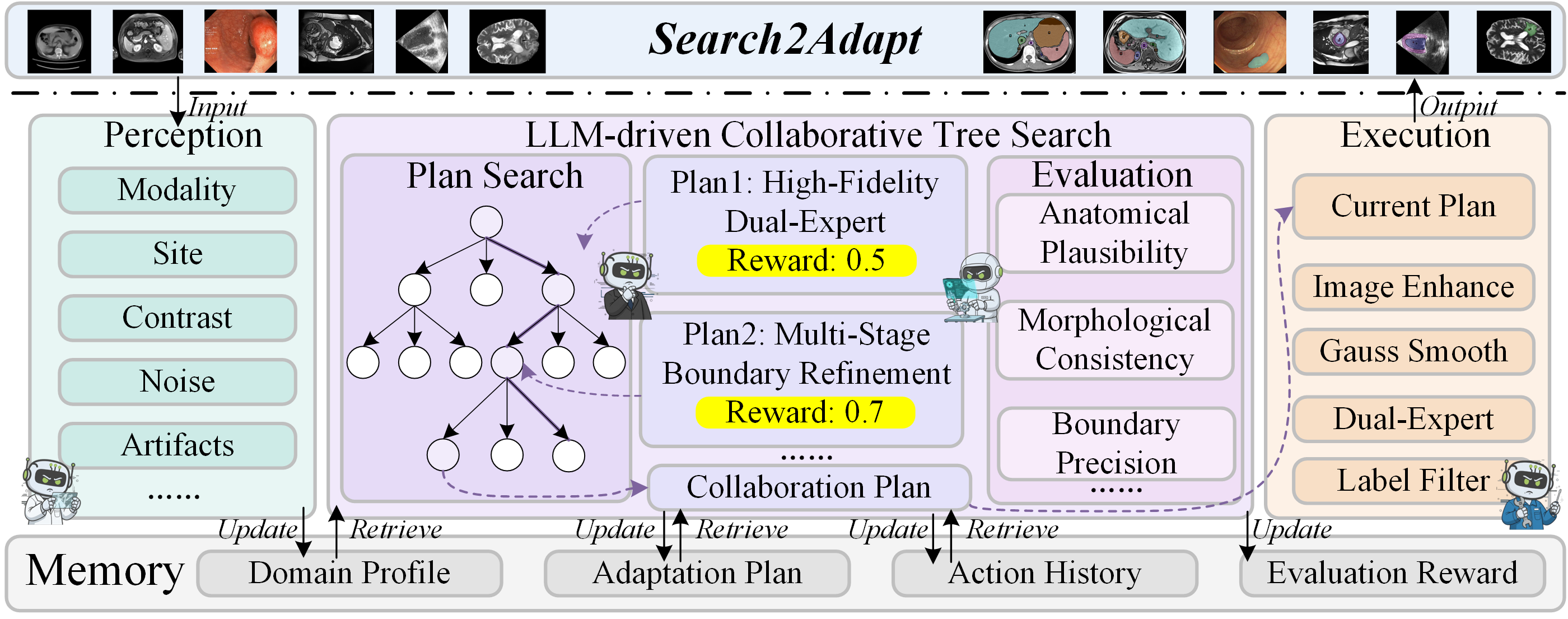
Overview of Search2Adapt. The framework employs a closed-loop multi-agent collaboration where Perceptor analyzes domain characteristics, Strategist proposes adaptation plans, and Evaluator provides feedback. CoTS explores the strategy space through tree search, guided by an anatomy-aware reward mechanism.

Method

Closed-Loop Multi-Agent Framework

Transforms traditional open-loop SFUDA pipelines into feedback-driven decision processes through collaboration between Perceptor, Strategist, and Evaluator.

Plan-Level Tree Search (CoTS)

Operates on complete tool-chain plans rather than individual actions, significantly reducing computational overhead while exploring diverse adaptation strategies.

Anatomy-Aware Reward

Multi-dimensional scoring mechanism that evaluates pseudo-label quality without ground-truth labels, considering anatomical plausibility, morphological consistency, and boundary precision.

CoTS Detail

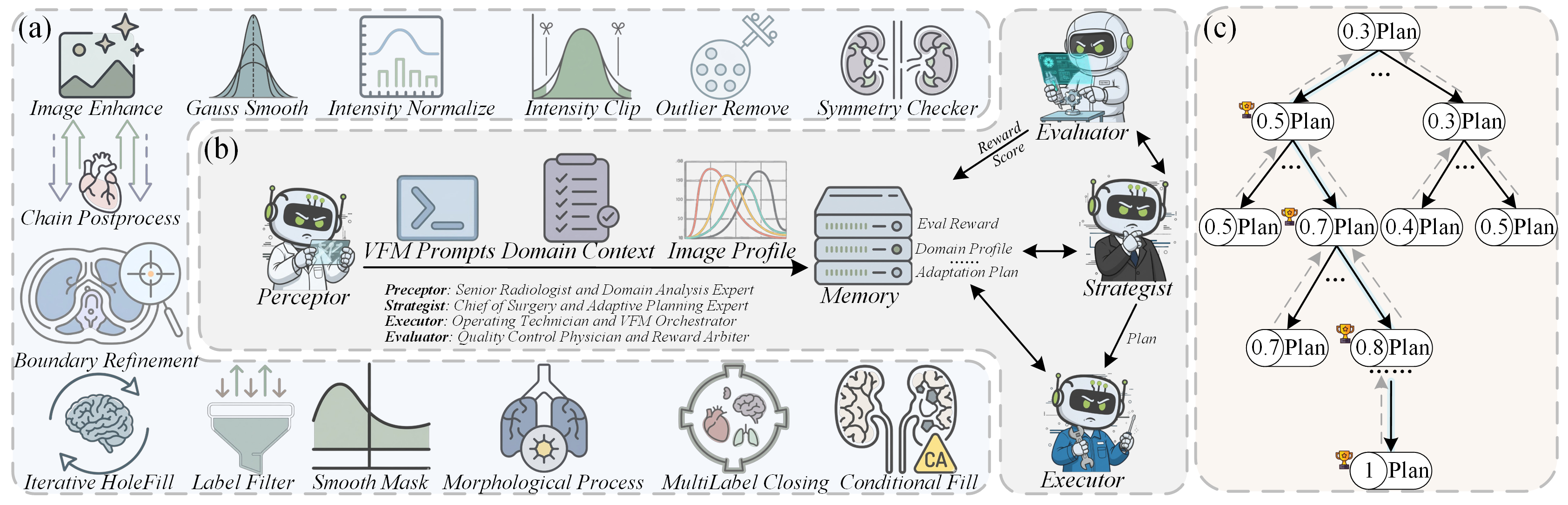
Collaborative Tree Search (CoTS). The two-phase search process: Phase 1 uses LLM-based plan evaluation without execution, and Phase 2 verifies top-K plans through actual execution. The diversity-augmented CAVF formula balances exploitation, exploration, and strategy diversity.

Key Features

Diversity-Augmented CAVF

Our Collaborative Action Value Function (CAVF) extends UCT with a diversity bonus to prevent premature convergence:

$$\text{CAVF}(s_i) = V(s_i) + w\sqrt{\frac{\ln N_{\text{parent}}}{N_i}} + \frac{\lambda}{\sqrt{\text{count}(\text{tool}_{\text{sig}_i})}}$$

Exploitation Exploration Diversity Bonus

Dynamic Prior Memory

Five-layer memory structure enables cross-sample knowledge transfer:

  • Domain Profile — Perceptor's analysis of target domain characteristics
  • Adaptation Plans — Strategist's candidate plans with success history
  • Trajectories — Successful tool chains for similar domains
  • Plan Dialogues — CoTS collaboration records for learning
  • Evaluation Records — Historical scoring for strategy refinement

Results

82.7%

Mean Dice on AMOS abdominal targets (MR→CT), outperforming all baselines by 60%+.

94.2%

Dice on cardiac MYO (MR→US), matching supervised performance in cross-modality setting.

92.9%

Dice on fundus OD (RIGA→BASE3), achieving competitive performance across all target domains.

13 Domains

Validated across 13 adaptation directions and 24 anatomical targets with consistent improvements.

Abdominal Segmentation (AMOS)

Dice scores (%) on 15 abdominal organs. Best results in bold.

Method Spleen R.Kidney L.Kidney Gallbl. Esoph. Liver Stom. Aortic V.Cava Pancr. R.Adre. L.Adre. Duod. Bladder Pros. Mean
UPL 23.97.730.20.012.523.610.79.30.78.60.00.02.00.00.08.6
ProtoContra 5.611.97.34.337.540.125.138.629.239.10.00.017.60.00.017.1
IAPC 8.74.51.91.34.515.214.39.74.62.00.00.02.219.87.26.4
◇ DFG 0.728.74.10.035.135.016.613.022.029.70.00.021.20.00.013.7
◇ IPLC 0.00.00.00.00.065.410.56.64.13.80.00.00.00.00.06.0
◇ SRPL 0.00.00.00.041.047.642.266.026.246.60.00.029.40.00.019.9
◇ Search2Adapt 96.595.395.082.479.197.086.994.645.381.274.276.178.078.880.582.7

Qualitative Results

Qualitative Results

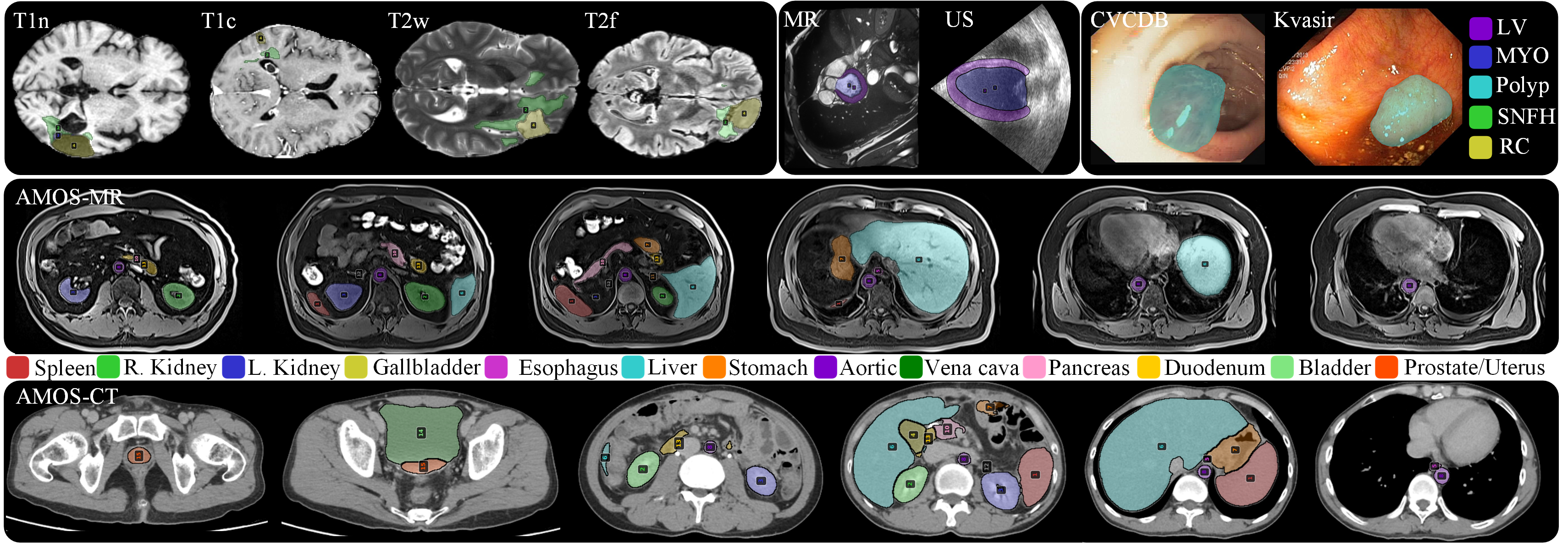
Qualitative results across diverse domain adaptation directions. Rows 1-2: abdominal targets; Row 3: cardiac, polyp, and brain targets.

Cardiac & Polyp Segmentation

Dice (%) and ASD (mm) on cross-modality cardiac and cross-dataset polyp targets.

Method Cardiac MR→US Cardiac US→MR Polyp Kvasir→CVCDB Polyp CVCDB→Kvasir
LVMYOLVASDMYOASD LVMYOLVASDMYOASD DiceASD DiceASD
UPL 2.80.090.5N/A 0.52.988.985.6 67.12.260.211.4
ProtoContra 1.217.054.956.4 5.24.972.974.8 78.00.968.99.5
IAPC 18.43.151.397.9 25.85.634.142.6 73.34.461.213.7
◇ DFG 4.64.551.663.1 2.36.969.366.5 19.197.526.887.5
◇ IPLC 1.75.850.548.3 2.911.548.426.1 34.834.745.319.2
◇ SRPL 0.70.983.179.8 8.59.130.145.9 33.031.444.918.9
◇ Search2Adapt 87.994.23.02.2 89.795.20.30.2 86.07.187.410.6

Fundus Segmentation (RIGA → BASE)

Method Dice (%) ASD (mm)
BASE1 ODBASE1 OC BASE2 ODBASE2 OC BASE3 ODBASE3 OC BASE1 ODBASE1 OC BASE2 ODBASE2 OC BASE3 ODBASE3 OC
◇ SRPL 90.586.388.787.789.689.9 5.96.76.07.05.95.7
◇ Search2Adapt 92.384.989.385.492.988.4 6.57.86.78.03.96.4
Fundus Results

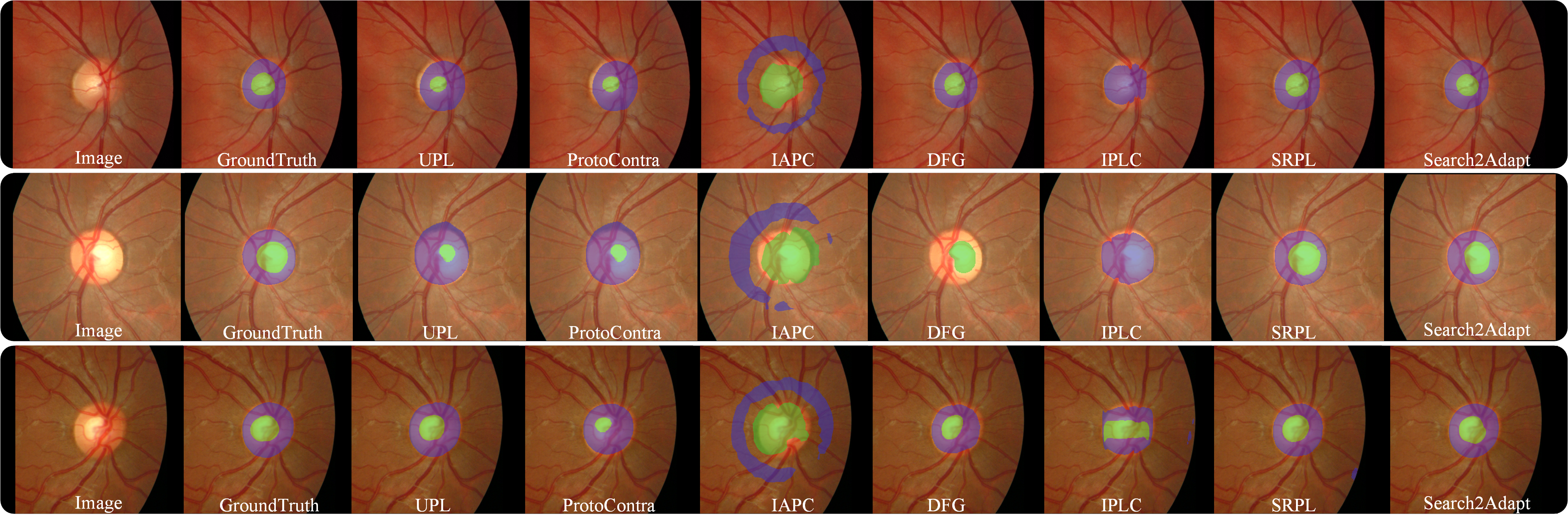
Fundus qualitative results from RIGA to BASE1, BASE2, and BASE3.

Ablation Studies

Component Analysis (MR→CT)

Variant Spleen Liver Pancr. V.Cava Mean Dice
w/o Perceptor 96.197.281.05.280.2
w/o CoTS 95.796.679.414.879.9
w/o CoT Diversity 96.597.281.53.880.5
w/o CoT Reflection 95.695.774.815.376.2
w/o VFM Postprocess 96.096.178.210.178.9
Search2Adapt (Full) 96.597.081.245.382.7

BibTeX

@inproceedings{shi2026search2adapt,
  title={Search2Adapt: Multi-Agent Collaborative Tree Search for Source-Free Unsupervised Domain Adaptation},
  author={Yulong Shi and Wenwen Zhang and Ziyi Li and Lin Qi},
  booktitle={Proceedings of the 34th ACM International Conference on Multimedia},
  year={2026}
}